Social Modulation of Pain
Before I joined Dr. Andrey Ryabinin’s lab in the Department of Behavioral Neuroscience at OHSU, social modulation of pain had already become an intriguing topic in the field. It is an extraordinary observation but not surprising that rodents, after interacting with a companion in pain, would not only exhibit similar pain-like behavioral responses as if they feel the same, but also show helping and caring behaviors. Sounds like empathy, right? But let’s stay on the side of behavioral observation first.
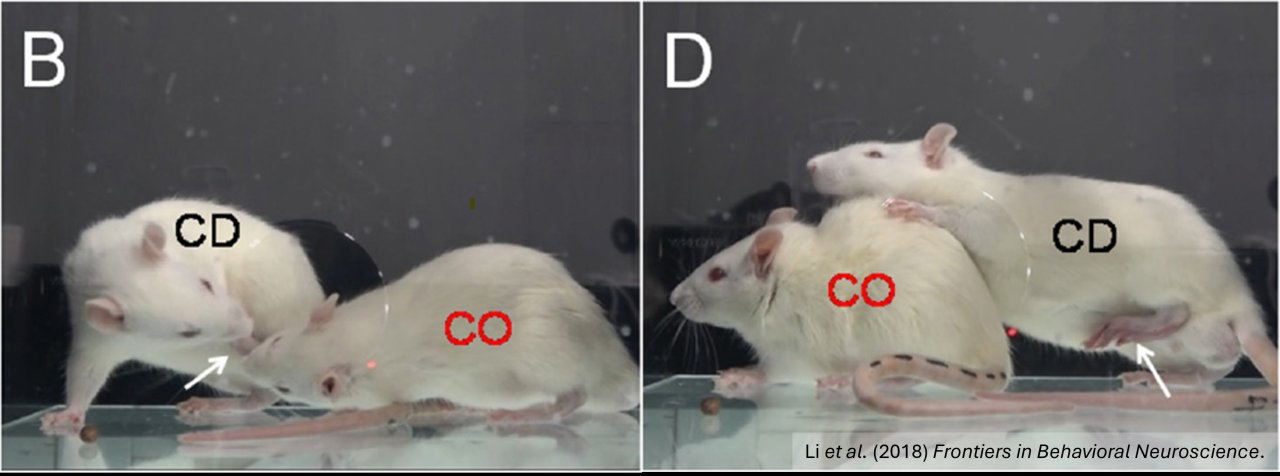
Andrey’s original contribution to this topic came from serendipity. He is a steadfast and prolific neuroscientist, aiming to understand the neurological mechanism of alcohol and substance use disorders and how social elements contribute to progression of the disorders. Before my time in the lab, Andrey’s team, while studying alcohol withdrawal-related pain in mice, discovered that healthy control mice housed with the cage mates that are in withdrawal also displayed pain-like behavior similar to withdrawal-related pain (Smith et al. 2016). One step further, it’d only require the bedding of those cage mates in alcohol withdrawal to precipitate such behavior in control mice. This means that the control mice smelled something from the bedding, which then caused them pain.
This finding created more questions: What is it in bedding that can cause pain? Is this “something” related to alcohol, alcohol withdrawal, or is it related to pain in general? How did it work? I joined Andrey’s lab to tackle these questions. My work published in European Journal of Pain explored the first two questions and demonstrated that it was not just the bedding from mice in alcohol withdrawal caused control mice pain; bedding from mice in an inflammatory pain also caused pain in healthy control mice. My results also showed that mice must be able to smell to feel the pain with the bedding in my study. This means that the pain-inducing chemicals in the bedding acted through the sense of smell, but not other senses like taste or skin contact.
I remember reading hungrily about other researchers’ findings and about what it all means to understanding empathy, feeling beyond excited about the prospect of probing the neurological mechanism of empathy. In the end, I chose to explore the chemistry rather than the neuroscience behind my finding. Perhaps it was my chemistry background making it so, but I felt that identifying the chemical input that led to the cascading effects was a more interesting gap to bridge than finding the pathway in the brain from an olfactory signal to a pain signal. Then perhaps we as scientists would be one step closer to finding the physical source of “pain contagion”.
To my great honor, the European Federation of Pain gave me the EJP Award in 2025 for this work, to recognize one of the two best articles published in the journal from 2023 to 2024.